Found Wanting: 25 Years of Service
Feb. 26th, 2023 05:15 pm![[personal profile]](https://www.dreamwidth.org/img/silk/identity/user.png) lb_lee posting in
lb_lee posting in ![[community profile]](https://www.dreamwidth.org/img/silk/identity/community.png) infinitysmashed
infinitysmashedWord Count: 4200
Notes: The cowboy record, in case you’re wondering, is Slim Whitman. The “yodeling horror” is probably his work best known to current-day audiences; it’s “Indian Love Call,” AKA the racist mind-blowing song in Mars Attacks! The other is “Secret Love.”
Story Index
25 Years of Service
Staying celibate isn’t a hard promise for Grey to keep, at first. She’s too busy trying not to wash out. Thanks to Vicky, she now knows that she can learn… but it still takes a while, and she can’t afford to lose this. Andersen is sponsoring her training; she can’t disappoint him.
The first year is all training. The physical parts aren’t so bad—it reminds her of wrestling—but the book parts are awful. Rules, regulations, hierarchy and names and history. (She also has to study a language; thank goodness “StanG Sign Language” is an option.) She takes to running at dawn, using the motion to pound the knowledge into her head. She barely makes it.
The second year, she starts the job, and it’s even worse, because now her actions have consequences far larger than her own failure. She has to protect people, help them, talk to them. She flails, fumbles, forgets. Her throat locks, and her SGSL is barely rudimentary. Everyone seems exasperated with her, and finally Andersen takes her aside and says, “Get your tongue untied, boy.”
As a child, when Grey stopped talking, her parents dragged her through a series of doctors, psychiatrists, and speech exercises. The only one with any efficacy was scripting her responses, which makes her feel like a parrot, but better a parrot than a failure. At least all the rules and regulations give some boilerplate to start with.
It’s unpleasant and makes her coworkers think she’s angry all the time, but it works. Around year three, things start coming together.
Come year four, Grey knows she’s going to make it. Thanks to scripting, she can speak, however stiffly and blankly. Her exhilaration knows no bounds. She’s learning! She’s doing this! Her bubbe and zayde rejoice.
In year five, they’re gone. Flu. She sits shiva, legally adopts their last name in memory. She works harder.
By year six, she’s getting some bemused attention from her superiors—except Andersen, who acts like he expected nothing less. Her crush is long gone, but she’ll always work for him and he knows it. When he transfers to Arizona and asks her to follow, she does; she has no reason not to, now. In Vago, nobody knows her old name or rocky start. They treat her competence as a given. It feels wonderful.
Desire starts coming back, now that she has room for it, but Grey ignores it. More and more people have gotten fizzy boxes, and she’s had years of practice redirecting her feelings and desire. She’s given up so much for the PIN already. Why not this?
It’s not like she’ll get it anyway.
…
In her late twenties, Grey ranks Specialist. It’s a step up in responsibility and puts her back in the morass of learning, adjusting, and playing catch-up, but she feels up to the challenge this time. As an extra bonus, Specialist is a gender-neutral title and almost everyone in Ops goes by their last name, so nobody wonders at calling her Grey. People don’t even know her first name anymore.
She loves her uniform, the navy blue suit, the gold rings at the shoulders. It’s a sign of how far she’s come, and men and women alike wear it, which feels good. When she shaves, does up her buttons, and knots her tie, she isn’t herself anymore, but an anonymous personification of order. It feels good to leave all the mess of her behind.
When she makes Specialist, she gets a permanent comboy: Ms. Margaux. She’s one of Johnson’s original hires, a chain-smoking old mummy of a woman with a creaky witch laugh. Nothing phases her, and Grey takes comfort in her patience, her oft-repeated phrases and stories.
They’re not close, exactly. Grey doesn’t get close to people. But their relationship grows over the years like a vine making its way up a wall. They both appreciate routine. Neither mind companionable silence, or taking things slowly. Working with Ms. Margaux feels good, comfortable.
One morning, as Grey’s driving to work, she sees Ms. Margaux waiting at a bus stop with her big beaded purse and the enormous jug of sweet tea that the docs keep trying to get her to give up. Grey pulls over and offers a ride.
“Well, ain’t that a kicker! I didn’t know you lived down here, Grey.” Ms. Margaux gets in, tucking her jug down between her feet. When Grey moves to turn down the opera, Ms. Margaux stops her.
“I like this one. But you know, if you’re asking me, you have to try Mario Lanza’s performance…”
For the rest of their decade-plus work partnership, they share music and the commute, filling Grey’s car with tapes. Mostly, they listen to the music or sing along together. They don’t need to talk, but sometimes they do, and Grey learns bits and pieces about Ms. Margaux’s life, like her son’s wedding.
“He’s about your age; I wasn’t sure he would ever find someone! But I’m glad he did. It’s not good for people, being alone.” She looks at Grey. “Do you have someone, Grey?”
Grey shakes her head. “No.”
“No one you fancy? You’ve never said.”
“Not a people person.”
Ms. Margaux can’t argue that; nobody can. But she looks at Grey a long time, then says, “Well, that’s too bad,” like she’s halfway to figuring out why Grey never mentions women or exes, has no photos of loved ones on her desk.
For a moment, Grey wants to tell her. She likes Ms. Margaux. She likes their commutes, their tapes, their routines. But that’s exactly why she mustn’t. She can’t afford to lose this, lose her, to something petty like the life she’ll never lead. It doesn’t matter. It hasn’t mattered in years. It’ll never matter.
So when Ms. Margaux says, “Do you—” Grey interrupts, “It’s personal.”
The words sit between them like a toad.
“All right, all right,” Ms. Margaux says. She sounds sad. “That’s fine. I’m sorry for pushing.”
She never brings it up again.
…
A few times, Grey thinks about apologizing, telling her. But her throat locks and she never does.
And now Ms. Margaux is gone. Everyone thought it’d be the diabetes (and the sweet tea), but the cancer got her first.
Her funeral is well-attended. It turns out that while Ms. Margaux’s husband is long passed, she has family, children and grandchildren, a church and knitting circle; there’s barely enough room for everyone. That feels right. It hurts less to think she’s so beloved.
Grey stands out. She’s big, she’s white, she doesn’t know any of the hymns or have any knitting gear. While going down the line and shaking the hands of Ms. Margaux’s children, giving condolences, a stately man who proves to be her son (the one who married late) asks, “I’m sorry, who are you?”
“Grey. Work partner.”
The man’s expression clicks; apparently Ms. Margaux talked about her. He tells Grey to stay, there’s something he needs to do, but it gets lost in all the people and grieving, so it doesn’t end up happening.
Grey’s mostly forgotten about it when a few months later, she gets a call from Agatha at reception.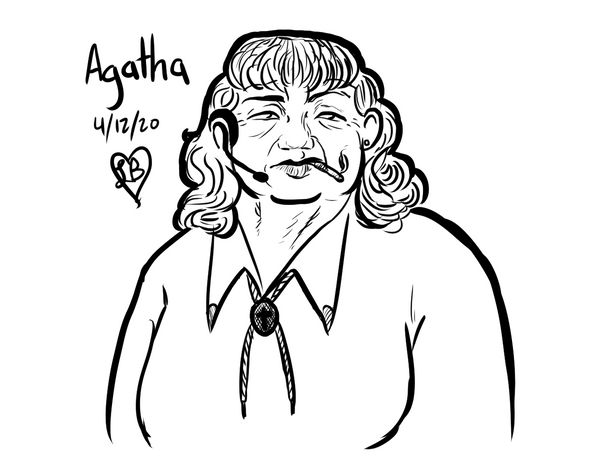
“There’s a package for you.” Agatha’s tone is disapproving. “It’s clean. Get it at home next time.”
It turns out that Ms. Margaux left Grey something, but she didn’t have proper contact information written down (or if she did, it got lost) and it’s taken this long for everything to get sorted out. In the package are two records—a 45 and an LP. Attached to the album sleeves are sticky notes, in Ms. Margaux’s crabbed handwriting: “Grey—hope you like. If not, burn so I can listen downstairs.” She can imagine the witch’s cackle at the end: ee-hee-hee.
That evening, Grey stretches out on the living room floor next to her stereo (inherited from her grandparents) and listens. The LP is an old performance of Treemonisha, an opera she doesn’t know. It’s nice.
The 45’s performer (as depicted on the album sleeve) wears a cowboy outfit and a pencil-thin mustache. It doesn’t look like something Ms. Margaux (or Grey, for that matter) would enjoy, but nevertheless, Grey puts it on.
The A-side is some yodeling warbling horror that she will never listen to again. The B-side, though holds a song about secret love, yearning to be free, and Grey goes still, staring at the ceiling.
No one was older guard than Drusilla Margaux. No one knew the PIN policies better than her; she’d been with them through the civil rights movement, through the attempted purges after Johnson’s death. If she had suspicions about Grey, she would never write it down or say it in any way that could get her caught.
Grey looks at the sticky notes again, still attached to the album sleeve: “hope you like.” The cowboy yodeler sings about the open doors of hearts and letting go of secrets.
Grey will never know.
…
It takes a while to adjust to the Ms. Margaux-shaped holes in her life. Before that last hospital stay, Grey was driving halfway across town to pick her up and drop her off, and now all that time hangs empty and silent—no more detours, no more tapes, no more Ms. Margaux. Like a big statehouse that’s gone but the roads act like it’s still there.
Grey tries to rebuild, find new ways of being around people. She starts working out at Health and Medical. Lots of first shifters unwind at the same time, and the sound of her coworkers chatting, lifting, or kvetching is nice background noise. Even coworkers who should know better sometimes treat Grey like she’s deaf or inanimate, so she can keep up on gossip as long as she keeps her mouth shut.
At home, she takes to eating dinner on the couch while watching TV. Barbarian Barbara is her favorite, a warrior woman who saves the day and kisses handsome men. She also watches an old painting show, hosted by a man with a soothing Vicky-like voice that helps her sleep on bad nights. She might not have someone to come home to, but she could do worse than a friendly voice and a kind face who isn’t unhappy to see her.
She takes to sleeping on the couch. Her bedroom feels too empty.
…
There are rumors about Specialist Larkin, that she’s a lesbian.
She’s a transfer from Mississippi with a voice made for radio; no matter how upset people are, she’s calming and professional, a good leader. Grey wants to get to know her better, but how? Asking her to drinks or coffee sounds like a romantic interest, disastrous. Their gym routines are different. Larkin’s not even on first shift, half the time, and when she is, Grey’s throat locks tight—something which only gets worse the harder she tries to speak. Grey has spent years getting good at her job, but she’ll never be sociable, and finally, she gives up trying.
Then she walks in on Larkin and Doc Pritchard kissing in the stairwell.
They all freeze. Larkin’s face becomes the professional mask she wears in hostage situations. Grey tries to speak, but her throat locks, and she knows that the longer she waits, the worse it’ll be, so in panic, she about-faces and flees.
Larkin follows after her as quickly as she can without drawing attention, straightening her clothes. Under the mask, Grey can tell that Larkin is afraid. They both know the work policy.
“Let’s talk,” Larkin says in that smooth Mississippi River voice.
Grey nods, and they move out of the building to Grey’s car.
Larkin keeps using her work voice, the one for aggravated armed people. “Is this going to be a problem?” she asks.
Grey tries to think of the right words. She thinks of Ms. Margaux, of the cowboy yodeler, and when her mind threatens to freeze, she blurts, “I’m a feygeleh.” It’s the closest way she knows how to say it.
Larkin jolts. Looks Grey over. The mask pops off and she sags in the car with a whoosh like a marathon runner who’s just crossed the finish line.
“Oh, thank Jesus,” she says in her normal voice. “Don’t scare us like that. Come on, let’s go tell Taneesha she ain’t getting washed today.”
And then they’re friends.
…

Larkin and Pritchard—well, Ebony and Taneesha—change everything.
They’ve both been out of the closet for years, everywhere but work. They live together in the gayborhood of Autumnville, go to a gay church, have gay friends, and are involved in various gay groups around town. It’s a whole world that’s always been there, and Grey never knew.
Pritchard’s family is supportive. Larkin’s isn’t (“preacher’s daughter”) but she’s built such a massive circle of loved ones that she thrives regardless.
“Oh sure, it hurt then and still does sometimes,” she says, “but it’s their problem, not mine.”
She says it casually, offhandedly, but Grey has to sit and think about it for a while. Their problem, not hers.
She becomes more Larkin’s friend than Pritchard’s—Ebony doesn’t mind long stretches of silence, but Pritchard seems to think the air needs filling, and anyway, she’s not Ops like they are. They try to have Grey over for parties but that’s a failure—too many people, too much conversation. It’s overwhelming, and Grey can tell most of the other guests find her off-putting, a looming, scarred-up stranger who doesn’t talk. Nobody needs that.
She and Larkin work out on Fridays, though, and have periodic TV nights, watching sports, Barbarian Barbara, or Disasters in Dykeland, a low-budget soap opera that Grey doesn’t understand but watches anyway. It’s soothing to see a TV show with a racial breakdown like their workplace but where everyone, from the detectives to the heiresses to the auto mechanics, are gay women. (And also because Ebony has stars in her eyes for the actress who plays the heroic OB-GYN and her evil con artist twin sister.)
At one point, the heroic OB-GYN gets a new next-door neighbor. She’s big like Grey, terse like Grey, a bodybuilder with short hair. Her name is Bea. She’s transsexual.
The first time Bea appears on the screen, Grey freezes dead with a nacho in her hand, flooded with recognition. She’s seen transsexuals before, of course, but they’re all soft and pretty. This is the first time she’s seen one like her.
Unaware, Larkin gets up for more drinks and snacks, asks if Grey wants some, but Grey just shakes her head and keeps watching.
Bea becomes her favorite character on Disasters in Dykeland. She’s never the butt of a joke, never called a man even when she fixes a car engine, builds muscle mass, or gets angry. She gets a girlfriend, dumps her for treating her badly, and goes on a three-minute monologue on the joys and sanctity of self. Larkin wanders off to use the bathroom, but Grey sits riveted and munches tortilla chips while “women come in all shapes and sizes!” rings out from the screen. For Larkin, it’s old hat; for Grey, it’s a paradigm shift.
It takes her a few weeks to tell Larkin, but she doesn’t want another Ms. Margaux situation. Grey’s getting older, her joints are starting to go, and she’s having a harder time living with the idea of dying alone. Still, she’s afraid when she tells Ebony, “I’m like Bea.”
Ebony thinks it over, then nods like this doesn’t really surprise her. “Okay,” she says. “You want to change anything? What I call you?”
Grey shakes her head. The girl in her is nameless, but now naming her is an option. On the surface, nothing’s changed, but her heart opens anyway.
…
In early 2001, Grey almost gets disemboweled. When she comes to in Health and Medical, she’s swathed in bandages and a coworker’s doing the crossword in a chair across from her. It’s been a while since she’s needed a vigil; there must’ve been concern that she wouldn’t make it.
When Grey stirs, the agent looks up, relieved—then uncomfortable. “Oh hey, you’re awake. I uh, better get Doc Richardson.”
Richardson has sharp features and hair that’s stayed platinum blond into adulthood. He’s never liked Grey, which is a boon; he’s blunt and to the point.
“I put your guts and dick back together as best I could, but…” The silence hangs. “You’ll have to keep me apprised.”
“Okay.” Grey will die before she discusses her genitals with Richardson.
She goes home. Richardson doesn’t like it, but he can’t stop her. Larkin and Doc Pritchard drive her home in their van and get her ensconced on the sofa with the TV and gallons of soup and Recharge.
While Larkin’s out grabbing groceries and toiletries, Grey asks Pritchard how bad it really is. At first, Pritchard doesn’t understand the question; she thinks Grey’s worried about the usual things. It’s excruciating, but there’s nobody else to ask, nobody Grey feels safe asking, and she finally manages to communicate: will this affect her ability to…?
Pritchard doesn’t look repelled or contemptuous, but all she can say is, “There’ll be scar tissue. Who knows how that’ll pan out. Richardson’s a pig, but he’s right. You’ll just have to keep an eye on it.”
Then she offers to handle the catheterizing, which is a relief to say yes to. Pritchard doesn’t understand Grey, but she doesn’t treat Grey like a man either.
Grey spends a week on the couch, sleeping and watching Larkin’s box sets of Disasters in Dykeland. Pritchard checks up on her regularly, signs off to do it officially. Larkin’s schedule is unpredictable as usual, but she manages to make it over at the same time as Pritchard one day to watch women’s basketball. (Grey isn’t a big fan, but what matters is the company. At least the scoreboard insures she can keep the basics straight, even with the drugs.)
She moves as little as possible. She doesn’t know what she looks like under the bandages, but whenever she shifts, she can feel the pull on the stitches all down her front. She tries to take as little of the Vicodin as possible; she’s learned the hard way that it makes her horny and stupid.
Most of the bandages come off and her catheter comes out after the first week. Pritchard treats her with awkward professionalism, not pity or horror, but Grey wants to take her first shower by herself, so she shoos Pritchard out. Only once the door is shut does she take a good look at herself.
A dark-stitched railroad runs down her front. More scars. Her genitals, well, they’re in one piece. At least her innards seem okay; she didn’t relish the idea of a permanent catheter, since it’d likely cost her position.
She looks at herself in the mirror, grimaces at her haggard face, unshaved for a week. She reaches down to touch herself and finds only numbness.
She sighs. Maybe this is for the best. For as long as she’s with the PIN, she can’t be anything but what she is right now, and she’s never going to leave the PIN. The option might as well be taken off the table permanently.
It’s fine. She has her job. That’s all that matters.
…
After Grey recovers enough to return to work, she discovers that her libido is unscathed, even if her body is not. She needs to learn new workarounds, and the interim is maddening.
To make matters worse, her work life is in flux. After Ms. Margaux’s death, Grey worked with Darlene, but now Darlene’s been promoted—well-deserved and long overdue, but Grey’s been shuffled through temp comboys ever since.
Diaz at HR has no sympathy. “If you want the nice ones to stick around, stop scaring them off.” As though Grey does it on purpose.
The latest is a young “cool Mormon,” oppressively friendly, and Diaz gets her wish, because Grey can’t get rid of him. No matter how she stonewalls, Penn keeps getting into her personal space, trying to make them bro-buddies, and it’s maddening. She’s restless, sexually frustrated, missing Ms. Margaux, and it takes all her focus to make it through the shift. When she clocks out, it’s with a sigh of relief; at least now she can get some time to herself.
But then Penn pops up, seemingly out of nowhere, gym bag over his shoulder. “You hitting H&M too, bro? Awesome!” He punches Grey in the shoulder, making her flinch. “Let’s do some reps!”
Grey looks in mute appeal at Larkin, who spreads her hands.
“Sorry, I have a church dinner with my name on it.”
Penn’s ears prick. “Where do you worship?”
Rainbow MCC, but Larkin can’t say that. “Around. See you Friday, Grey.”
Grey waves goodbye and tries not to sigh. It’s not Penn’s fault; he’s just in the wrong place at the wrong time. There’s no polite way to escape, asides from avoiding the gym entirely, and exercise is the only release she has right now, so she lets Penn herd her.
He looks so pleased; she feels bad for not liking him. He wants so badly to be her friend.
“That Larkin is a heck of a woman. Is she… you know…?”
Grey just stares at Penn until he looks away.
“Just wondering. You two involved?”
“No.”
Penn lights up again. “More for me! Eh?”
Grey wishes she could say that Larkin is taken, but she can’t. All she can do is ignore Penn’s hand, held out for a high-five.
Penn’s smile doesn’t dim. “That’s okay, bro; I know you’re happy for me.”
The whole workout is an exercise in frustration. Penn stands too close, makes a production out of his reps, puts his weights back improperly, and combined with the gnawing aching want Grey’s stuck with, it’s unbearable. Normally, Grey struggles with getting near people, not getting away from them. She doesn’t know what to do. This has never happened to her before.
“Steam room, bro?” Penn asks.
“No.” Torture, Grey is sure, is sitting in a broiling room with nothing but a towel and Penn.
She assumes they’ll part ways and that’ll be the end, but Penn follows her to the showers nonetheless and insists on washing with the curtain open: “all bodies are God’s bodies, bro!”
Grey yanks her own curtain shut and pulls at her hair. Why is Penn acting the meshugana? Because he’s Mormon? Because he’s Penn? There are a million people who would happily be his friend, people who aren’t her. What does he want from her?
She blinks. Wait…
No. Impossible. Penn’s young, handsome, sociable. He’s Mormon. Surely he’s not flirting with her.
It would explain all this, though…
If Penn is indeed flirting, Grey isn’t flattered. She’s aghast. (And resigned; of course, of all the times and all the men in all the world…) Bad enough when she thought Penn was just out to befriend or convert her, but this…
She has to get rid of him. But how?
Grey starts to undress, and then she knows. The stitches are out, and the scabs have healed, but the scars are still raw and red, and she makes no move to hide them when she pulls back the curtain to put her clothes away.
Penn lights up—but then his eyes go down and his expression freezes.
Grey stares hard at him, not hiding her irritation. She feels some bitter satisfaction when he averts his eyes, clears his throat, and shuts his curtain.
He requests a transfer to third shift the next week. Problem solved.
…
Diaz’s HR office is right by the break room, so it’s impossible to get coffee without passing her. The morning after Penn becomes third shift’s problem, Grey tries to sneak past, but no such luck; Diaz pounds on the window.
“Hey Grey! Come meet your new comboy!”
Unable to refuse, Grey enters her office.
Penn was in his twenties, slim and white and smiling. The new guy is Grey’s age, short and round and Indian (the Mumbai kind, not the Darlene kind), with bifocals, gray hair at his temples and mustache, and a quizzical air. He’s turned around in his chair to get a look at Grey, and if he weren’t looking at her so dismissively, he’d be a very attractive man.
Behind his back, Diaz mouths the word, “wash hire,” points at him, and nods with gleeful satisfaction. Aloud, she chirps, “This is Babubhai Doshi.”
“Bob,” he corrects.
“Bob, this is Grey. Say hi.”
Grey just stands there. Doshi eyes her coffee jealously. The silence hangs.
“You’ll love each other,” Diaz assures them.
Doshi turns back forward to give her a contemptuous look, and Grey takes the opportunity to sidle out. As she does, she hears Diaz say, “Grey’s senior specialist with honors.”
“Great.” Doshi’s voice is acid. “I love boy scouts.”
Grey doesn’t mind if her new comboy dislikes her. That’s good—it’ll make him more inclined to transfer out, and the sooner he leaves, the better. Grey’s had twenty-five years to learn how to redirect inconvenient thoughts and feelings, but that’s hard when her body is clamoring for attention.
She can handle him. All she has to do is be herself as hard as she can.
He can’t be worse than Penn.
Story Index


