Found Wanting: Made Useful
Feb. 26th, 2023 04:43 pm![[personal profile]](https://www.dreamwidth.org/img/silk/identity/user.png) lb_lee posting in
lb_lee posting in ![[community profile]](https://www.dreamwidth.org/img/silk/identity/community.png) infinitysmashed
infinitysmashedWord Count: 2200
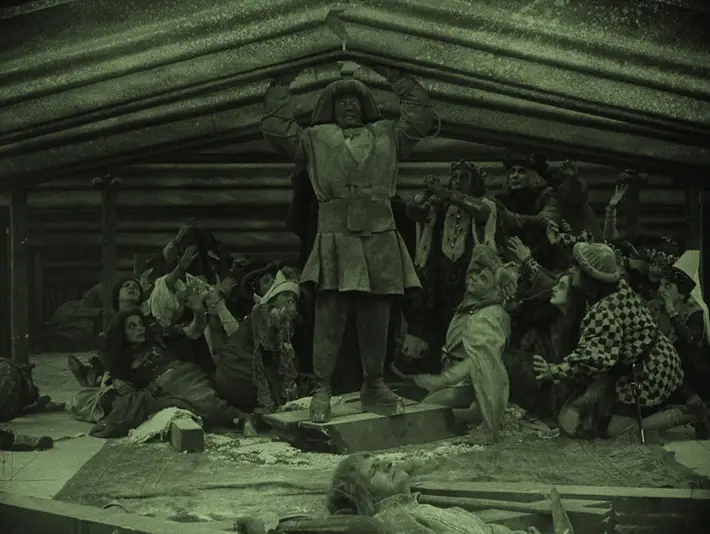
Notes: Feel free to imagine the most hideous '70s fashions available. Jesus, I can’t believe this is the first time Andersen and Vicky finally come up. The movie being mentioned, the Golem: How He Came Into The World, is a classic of silent horror film from 1920 and thus is in the public domain. You can watch it here, and the golem looks like this. Content warning for implied child abuse and awkward (consensual) heterosexual sex.
Story Index
Made Useful
In 1966, when Grey is eight, she sees an old silent movie called der Golem on dollar day at the drive-in theater. The film is faded and flickery, parts seem to be missing, and all the text is in German, but none of that matters once the golem appears. Grey’s too young to know what that leap in her heart means, but when she sees the golem’s dress and bobbed hair, her strength to hold up a collapsing ceiling, she knows that’s who she wants to be. She wants to be the girl who saves everyone, the woman who holds up the world.
And the golem gets away, in the end! Grey watches breathlessly as the clay girl runs amok, escaping the bossy men who keep ordering her around and ripping the magic words out of her heart. She leaves that horrible house and sets it on fire, even. She gets away. She dies in the end, but she gets away.
When it’s over, Grey’s parents ask her what she thought of it.
The words are a struggle, but this is when Grey is still trying to talk at home, and she’s so starry-eyed that she’s determined to say it: “Want to be her.”
Her father goes rigid. Her mother’s smile freezes. “Miriam?” she asks.
Grey shakes her head indignantly. She points to the poster up on the fence nearby, showing the golem’s funny scowling face. “Her.”
She quickly realizes that she has made a terrible mistake.
A bad scene results. Grey’s parents inform her that the golem is not a girl. It wears a tunic, not a dress, and its hairstyle didn’t mean “girl” then like it does now. Furthermore, the golem is not a heroine; it is a silent, stupid monster. The Maharal, the great man who creates the golem, is the true hero, the man Grey should emulate and aspire to be. In the real story, the proper story (which they tell Grey now, to insure she understands properly), the golem never rebels, never escapes. She does everything she is supposed to, without resistance or complaint, and when her work is done, the Maharal takes her up into the attic of the schul and turns her off, leaving her (not dead, they insist, deactivated) among the torn prayer books and worn prayer shawls. That is what a golem is for.
That is how the story is supposed to go.
When the lesson is complete, Grey realizes why the golem is always silent. A truth written on the heart but never spoken is harder to tear away.
Grey will never be a girl, she realizes. She might as well be the monster.
…
In 1975, when Grey is seventeen, her bubbe and zayde grow too sick and frail to keep her, and she ends up back with her parents. It’s not like it used to be; she’s big now, big enough that they’re afraid of her, rather than the other way around. (Grey’s saddened by this, but it doesn’t show. She doesn’t talk or emote at home anymore.)
She goes out for wrestling, since they can’t stop her now. In motion, everything makes sense. It doesn’t matter that she’s a goylem whose words get tangled, that she’s bad at being a boy and worse at being a girl, that her grades are falling… until they get so bad she’s at risk of academic probation.
When one of her teammates hears about her troubles, he says, “My kid sister’s real smart. She got my grades up; maybe she can do it for you too.”
So when she’s a senior, Grey meets Vicky Engelmann, a tiny sophomore all hair, freckles, and glasses. When Grey’s parents warn her that Grey will never amount to anything, Vicky looks taken aback, then covers it with a polite smile and says, “I’ll be fine, thanks.”
Then she gets Grey out of the house. “Do they always talk about you like that?”
Grey shrugs.
It takes Vicky five seconds to realize that Grey learns better when she’s moving. (“Oh, Harold’s like that too! I must’ve taught him half of algebra in a hammerlock…”) They orbit the block a million times as Vicky explains things with a sketchpad. They don’t even get to the lesson they’re supposed to be doing, because Vicky wants to make sure Grey understands the prerequisites first. Grey doesn’t, but Vicky doesn’t roll her eyes or huff, she just goes back as far as she needs and builds from there.
When they’re done, she does a little victory dance. “We did good work today, Grey!”
Grey jolts. Nobody calls her by her grandparents’ last name except the wrestling team, at her insistence; Vicky must’ve picked it up from Harold.
She sees Grey’s expression. “Wait, sorry, should I call you…?”
“No,” she says.
She likes the way Vicky says it. It sounds right. Besides, Vicky’s voice is magic; it makes Grey want to curl up and purr like a cat in a sunbeam. She tells herself it’s attraction, even though it’s not the same as the burn she feels around some of her teammates. The burn, Grey wants to believe, is just adrenaline. She likes Vicky. She wants to be the kind of boy who likes Vicky.
Her grades scrape upward and the tutoring becomes less necessary, but Grey and Vicky keep meeting anyway, walking endless circles around the block together. Vicky introduces Grey to poetry, which is dead on the page but alive in her voice—Robert Frost, Yehuda Amichai, even Shakespeare, who always intimidated Grey too much to take in. After they’ve known each other a while, Vicky starts sharing her own poetry, all about stars, chemistry, and imaginary numbers. Grey doesn’t understand it but it’s beautiful anyway.
“You don’t have to listen to this if you don’t want to,” Vicky says, blushing.
“I want to,” Grey says.
After a poem about covalence, Vicky kisses her. It’s fine, easy to take the flood of relief (somebody likes her, somebody wants her) for desire. When Vicky asks to go steady, Grey says yes, and her parents haven’t been so happy in years. Finally, a sign that Grey’s good for something, somebody.
They go out the rest of the year. Vicky is easy to love. She isn’t like Grey; she’s going places, good at putting things together in new and different ways, like science and math with poetry. She’s kind, and not in a syrupy, charitable way. Through her eyes, the world is an interesting, marvelous place.
Which is why, after they’ve been together a while, Grey tries to describe the pleasant buzz she gets from Vicky’s voice. She can’t find the words, as usual, so tries to express it by undulating her hand and saying, “Feels good.”
Vicky turns pink and Grey realizes how it sounds; she tries to explain that no, it’s not like that, but her words get more and more tangled until they’re both sitting on the park bench, silent and mortified. Then Vicky sees Grey’s face and goes into peals of laughter, with her and not at her, and she hugs Grey and says in a goofy voice, “What are you wearing, Grey?” And then they’re laughing together and it feels good.
When Grey turns eighteen, Vicky gives her Leaves of Grass, not realizing that Grey only likes poetry when it’s Vicky reciting it. Still, Grey trudges through, reading it in bed to put herself to sleep. It works until she reaches the end of “When I Heard At The Close of the Day”:
“I heard the hissing rustle of the liquid and sands as directed to me whispering to congratulate me,
For the one I love most lay sleeping by me under the same cover in the cool night,
In the stillness in the autumn moonbeams his face was inclined toward me,
And his arm lay lightly around my breast—and that night I was happy.”
Grey shuts the book and hugs it to her chest, burning inside. She feels caught.
It can’t mean what it sounds like. They read Whitman in school, all that stuff about Lincoln and democracy. Grey’s girlfriend gave her this. All that talk of “him that tenderly loves me” has to mean something else, friends or brothers or something, or they’d never let her read it.
She reads it again, paying attention the whole way through this time. It still sounds exactly how she thinks it sounds, like it’s about someone who likes boys in the same forbidden way that Grey does. No matter how she tries, the poem still sounds like it’s about someone like her, loving a man and sleeping with him. It sounds… good.
Grey’s masturbated before, but never to poetry. Then she hides the book in her stack of textbooks and feels sick. She’s Vicky’s boyfriend now. She’s not supposed to feel this way anymore.
When prom comes, Grey asks Vicky to go, because that’s what boys do and it’ll make Vicky happy. Vicky wears a green dress and a supernova smile, and Grey takes reassurance in that, her parents’ pride. Finally, she’s doing things right, being what she’s supposed to be.
Afterward, she and Vicky have sex in the back of a borrowed station wagon. It’s awkward, messy, and afterwards, Vicky asks, “Did you… like doing that?”
Grey shrugs. She likes making Vicky happy. What else is there?
Grey tries not think about how often she rereads certain Whitman poems, or how earlier in spring, she wrestled a boy who looked like a superhero. He came up hard in her crotch hold, which happens sometimes and doesn’t mean anything, but when she saw his face, she lost her concentration completely and found getting pinned weirdly thrilling. Adrenaline. Just adrenaline.
Vicky and Grey have a lot of sex over the summer, but it only works if Grey takes her own desires out of the equation and focuses on making Vicky happy. (This becomes much easier once they discover cunnilingus. Grey doesn’t care what her parents’ copy of Human Sexual Pathology says; it’s an activity that doesn’t require Grey’s own genitals or voice, and it makes Vicky very, very happy.) Then it’s satisfying, though not erotic. Maybe she can be a boy if she does it this way, treats sex like something she does, not something she wants or enjoys. Vicky always seems guilty afterward, though.
“Are you sure?” she keeps asking. “I want to do something for you.”
This time, they’re squished together in the backseat of Grey’s father’s station wagon, under a picnic blanket with the unnecessary box of condoms. Grey snuggles close; this part, she likes. She tells Vicky what she always does:
“Poem?”
Vicky doesn’t seem to believe that Grey likes this, but she can’t resist either, because she loves spinning poetry as much as Grey loves listening to her. So Vicky weaves one about the constellations in her silk water voice, and she cuddles Grey and pets her hair, and it’s perfect. She dozes off.
Grey dreams of the superhero boy who pinned her. She dreams of an arm around her waist, ragged breath against her skin, autumn moonlight, and when she wakes up, Vicky goes, “Oh, so you do… want to try again?”
It’s the one time Grey manages to consummate the thing halfway properly, and it feels awful. Vicky, who looked so relieved and hopeful, sees Grey’s face and wilts.
“What’s wrong?”
She looks guilty again, like this is her fault, and Grey doesn’t know how to explain that it isn’t, it’s Grey, it’s always Grey that’s the problem, because Grey’s good for nothing, not even making Vicky happy. Vicky’s the only reason Grey got her diploma, she’s smart and kind and interesting, and Grey loves her and her voice and it’s not enough. If Grey can’t be a proper boy for Vicky, she’ll never manage it for any girl, ever.
Vicky’s talking now, trying to find out what’s wrong, how to fix it, like it’s her problem, and Grey can’t take it, so she tells Vicky everything.
Afterward, Vicky just sits there and goes, “Oh.”
There’s nothing more to say.
That night, Grey goes to her job pushing a mop, which she got because it doesn’t require her to talk to anybody and she finds cleaning empty buildings soothing and satisfying. As she cleans a hardware store, going through the familiar paces of wiping, mopping, and scrubbing, she makes her plan. When her parents find out Vicky’s gone, that there will be no other girls, they’ll be furious. But Grey doesn’t have to stay for it. She’s an adult now; she can leave. She’ll use the rest of the summer to get things together and save a little money, then join the Army. At least it’ll get her out of here. Maybe they’ll be able to make a man of her, finally.
She hears a clunk, something scurrying, and looks up from the toilet she’s scrubbing. Her neck prickles. Feeling silly, she grabs a claw hammer off the wall and goes to investigate, hoping it’s rats and not vandals.
It’s neither. It’s worse.
It’s like a small cougar, only it’s the wrong color and shrieks like a person and it makes Grey’s mind scream and scream. Then it tries to kill her.
Grey has only ever been good at one thing, and she’s had years of practice doing it regardless of her mental state. She goes into motion.
When Andersen arrives, with his PIN Neurophysics box and his gun and his unflappability, Grey is terrified, bloody, and surrounded by wall fasteners, but alive. Andersen kills the cougar and the screaming in Grey’s head stops, leaving her shaking and sweaty with adrenaline.
“My mistake,” Andersen says. “I didn’t hear you. You all right?”
Grey just stands there, wheezing. Her throat has locked tight, but Andersen doesn’t seem to notice, just hands her his handkerchief and starts tagging and bagging the animal.
“Your broadcast’s funny; must’ve mistook you for the Zar!” Andersen shakes his head. “Maybe that’ll do you favors someday.” In a decade or so, Ops and Neurophysics will separate and he’ll lead the former, but even now, as a young man with nobody to manage, he looks leathery and fed up. Still, he intervened and showed concern for her well-being, so in that moment, he’s the most heroic and handsome of men.
Grey hiccups and rocks and calms down as Andersen works. Her forearms go from stinging to throbbing, and they’ll scar, but she can still move her fingers well enough; she wraps them with Andersen’s handkerchief and her own. Because it’s her job, regardless of injuries or cougars, she picks up all the wall fasteners and puts them back in their places, washes the hammer and returns it, gets her mop to clean the blood and dirt off the floor. She’s already cleaned this aisle once, but it’s the principle of the thing. Andersen watches her with an unreadable look… listening, she realizes later.
Later generations of the Neurophysics box get more coherent and reliable, but Andersen will never upgrade. His box is a Johnson original, esoteric and synaesthetic, strapped to his back like old radio equipment, and it’s very good at what it does with enough interpretation. Even now, in 1976, Andersen’s had a decade of practice with it.
“You’re the janitor,” he says.
Grey keeps mopping. She figures her actions are self-explanatory.
“You’re not attached to this job, are you?”
Grey looks up.
“I work for a national agency concerned with the protection of people like you from things like that,” he says, nodding at the cougar in its bag. “It’s good, hard, physical work.”
Grey isn’t scared of hard work.
“Didn’t think so. Look, you’re big, obedient, and you know how to handle yourself. There might be a place with us for you… but none of that queer stuff.”
Grey freezes, but Andersen is unperturbed, just sits on his box and lights a cigarette. He’s small, wiry, and unafraid, clearly aware that he’ll win a fight.
“Relax, boy. Nobody else in Ops has a box; your secret’s safe with me.”
Later on, thinking back on it, that’s when Grey realizes that the boxes have limits. Because Andersen might be smart and skilled, but he only knows one of her secrets. In the moment, though, her mind is still trying to catch up with everything, so she doesn’t react, which is probably what saves her.
“Follow protocol and I could care less what you do with yourself,” Andersen continues. His eyes flick up. “Can you keep your dick to yourself?”
Yes. It’s not like it’s in demand.
Andersen smiles around his cigarette. “Then I’d say you’re golden. What do you say?”
Grey says yes, and finally, she becomes good for something.
Story Index